
Leave Your Message
AI Helps Write

10 Best Inverter Air Conditioners for Global Buyers

An Airconditioner Inverter adjusts compressor speed instead of repeatedly switching it on and off. That difference can matter during a long, humid afternoon. The room temperature stays steadier, and the unit may use less electricity under suitable conditions. Results vary. Climate, installation quality, maintenance, and sizing all affect real-world performance.

The International Energy Agency’s The Future of Cooling report projects that global air-conditioner stock could grow from about 1.6 billion units in 2018 to 5.6 billion by 2050. It also warns that cooling demand will rise sharply. These figures make efficiency more than a feature on a product label. It is a practical buying consideration. The U.S. Department of Energy likewise explains that variable-speed operation can improve comfort and efficiency, though savings depend on the system and how it is used. Amory Lovins, co-founder of the Rocky Mountain Institute and an energy-efficiency advocate, has often expressed a useful principle: “The greenest energy is the energy we don’t use.” The exact savings from an inverter model, however, should never be assumed from that principle alone.

This guide compares ten inverter air conditioners for buyers across different markets. We consider efficiency ratings, cooling capacity, noise, voltage compatibility, service access, and warranty terms. A quiet bedroom unit is not automatically right for a sunlit living room. Check local test standards, too; ratings are not always directly comparable. There is no single best choice. The details matter.
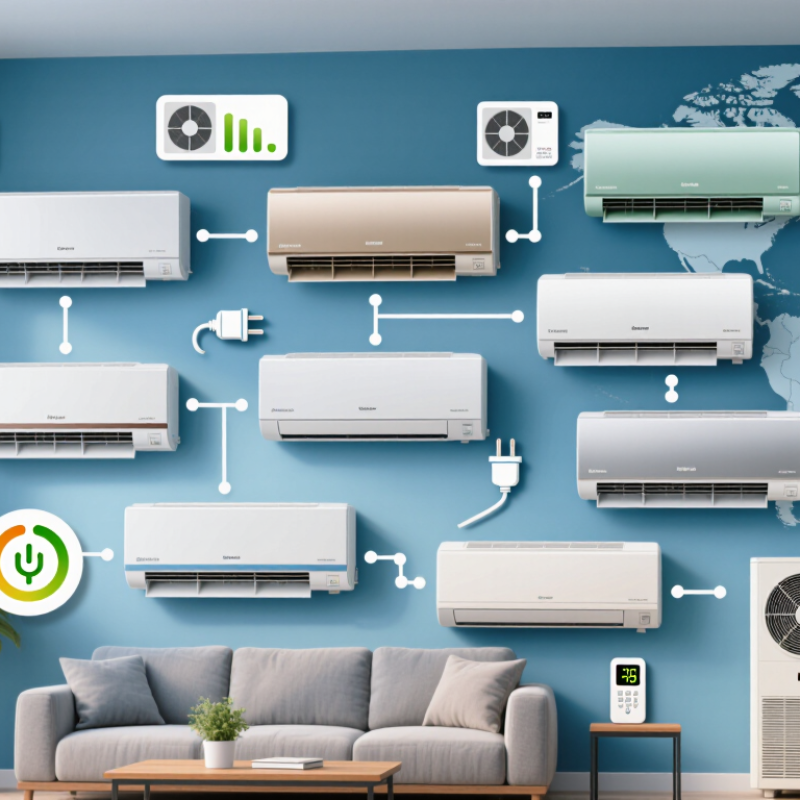
10 Best Inverter Air Conditioners for Global Buyers

Understanding Inverter Air Conditioners and How They Work

Understanding Inverter Air Conditioners and How They Work

An inverter air conditioner varies compressor speed instead of repeatedly switching it fully on and off. A sensor detects room temperature, then the control system adjusts compressor output to match the cooling load. On a hot afternoon, it may run faster; once the room cools, it slows down. Small adjustment, steady comfort. This can reduce temperature swings and avoid some energy lost during frequent restarts. Actual savings vary with climate, unit sizing, insulation, maintenance, and how the room is used.

The International Energy Agency’s 2018 report, The Future of Cooling, estimates that air conditioning uses nearly 20% of electricity in buildings worldwide, equivalent to about 10% of global electricity use.

The report also projects that energy demand for space cooling could more than triple by 2050 under current policies.

These figures explain why efficiency matters, but they do not guarantee a particular household’s bill will fall. An inverter still cannot compensate for a poorly sealed window or a clogged filter. And a too-large unit may cool the air quickly without removing enough moisture. Room comfort is a little messier than a lab rating suggests.


Key Criteria for Comparing Models Across Global Markets

For global buyers, comparing inverter air conditioners starts with the conditions they will actually face. A unit sized for a shaded bedroom may struggle in a sunlit room with large windows. Check cooling capacity against room area, ceiling height, insulation, and local peak temperatures. Bigger is not always better. An oversized unit may cycle inefficiently, while an undersized one can run hard for hours. Ask an installer to verify the estimate rather than relying on a rough online chart.

Efficiency figures need careful reading. Test methods, climate assumptions, and energy labels vary between markets, so two ratings may not be directly comparable. Look for the test standard and operating range behind each figure. Also confirm voltage, frequency, plug requirements, and local certification before purchase. Refrigerant type, warranty coverage, spare-part access, and service availability matter too. A low purchase price feels less attractive when a control board takes weeks to replace. Noise ratings can help, but room layout and installation quality affect what you hear.

Tips: Check the nameplate and manual for electrical requirements. Compare capacity at your region’s expected temperatures, not just a single headline rating. Ask who handles repairs locally. A comparison table is useful, but it can still miss awkward details, such as incompatible smart-home features or unclear warranty terms. That deserves a second look.

Ten Leading Inverter Air Conditioners for Different Needs

Choosing among ten leading inverter air conditioners starts with the room, not the feature list.

The IEA’s 2018 Future of Cooling report projects the global air-conditioner stock could reach 5.6 billion units by 2050, up from 1.6 billion in 2016. UNEP’s 2023 Global Cooling Watch also warns that cooling demand could more than triple by mid-century.

Correct sizing matters. For humid bedrooms, seek effective moisture removal; for dry heat, prioritize strong airflow. Small rooms need modest capacity and gentle modulation, while open-plan areas need wider air distribution. Light sleepers should compare low-speed sound ratings. Coastal households can check for corrosion protection.

The other needs call for different checks: cold-climate homes benefit from verified low-temperature heating performance; energy-conscious buyers should compare seasonal efficiency ratings; connected homes may value reliable scheduling controls; allergy-sensitive users can inspect filter design; and busy households may prefer washable filters and accessible service panels.

These are practical comparison points, not guarantees of comfort. A perfect match is rare. An oversized unit can still disappoint, even with inverter control, so check room area, ceiling height, sun exposure, and local climate before choosing.

Matching Cooling Capacity to Room Size and Climate

Choosing an inverter air conditioner starts with the room, not the largest capacity available. Measure the floor area and ceiling height, then consider direct sun, insulation, window size, and how many people use the space. A compact, shaded bedroom needs less cooling than a top-floor room with broad west-facing windows. Too little capacity can leave the unit running constantly on hot afternoons. Too much may cool the air quickly while leaving humidity uncomfortable.

Climate changes the calculation. In humid coastal areas, check whether the unit can remove moisture while maintaining a steady temperature; a cool room can still feel clammy. In dry, very hot regions, strong solar exposure and long heat spells may call for more capacity than floor area alone suggests. Inverter technology helps adjust compressor output as conditions shift, but it cannot fix a poor size match. Look at the manufacturer’s sizing guidance, and use local HVAC advice when rooms have unusual layouts or extreme exposure. Measure twice. I still find estimates based only on square footage tempting, but they can miss the afternoon sun that changes everything. A little uncertainty is better than false precision.

10 Best Inverter Air Conditioners for Global Buyers - Matching Cooling Capacity to Room Size and Climate
Rank Recommended Configuration Nominal Cooling Capacity Approx. Room Area Best-Fit Climate and Use Key Buying Considerations
1 Compact inverter split system 6,000 BTU/h (1.76 kW) 180–280 sq ft (17–26 m²) Mild to moderately warm climates; small bedrooms, studies, or enclosed offices. Check minimum output for steady operation in a small room. Confirm that the electrical supply and installation requirements match local standards.
2 Small-room inverter split system 7,000 BTU/h (2.05 kW) 230–330 sq ft (21–31 m²) Moderate climates; compact living rooms or bedrooms with limited direct sun. Consider a higher capacity if the room has large windows, high ceilings, several occupants, or substantial afternoon sun.
3 Compact bedroom inverter split system 9,000 BTU/h (2.64 kW) 300–450 sq ft (28–42 m²) Warm or humid climates; medium bedrooms and small living areas. For humid locations, compare the unit’s dehumidification performance and verify that condensate drainage is practical.
4 Small-apartment inverter split system 12,000 BTU/h (3.52 kW) 400–600 sq ft (37–56 m²) Warm climates; larger bedrooms, open-plan studios, or small living rooms. A single wall-mounted unit cools the space where air can circulate; closed rooms may need separate units or another system design.
5 Medium-room inverter split system 15,000 BTU/h (4.40 kW) 500–750 sq ft (46–70 m²) Warm to hot climates; medium living rooms or open-plan areas with moderate sun exposure. Ask an installer to account for insulation, ceiling height, window area, and local outdoor design temperatures before selecting capacity.
6 Large-room inverter split system 18,000 BTU/h (5.28 kW) 600–900 sq ft (56–84 m²) Hot or humid climates; large living rooms, shared family spaces, or open-plan interiors. Check airflow reach and indoor-unit placement. A room with separated zones may be better served by multiple indoor units.
7 Large open-plan inverter system 21,000 BTU/h (6.15 kW) 700–1,050 sq ft (65–98 m²) Hot climates; larger open-plan spaces with moderate heat gain. Confirm that the system’s operating range covers local summer temperatures and that the outdoor unit has adequate ventilation.
8 Extra-large inverter split system 24,000 BTU/h (7.03 kW) 800–1,200 sq ft (74–111 m²) Very warm climates; large connected living areas or rooms with higher-than-average heat gain. Use a room-by-room heat-load assessment where possible. Oversizing can reduce comfort and humidity control, even with inverter operation.
9 High-capacity inverter system 30,000 BTU/h (8.79 kW) 1,000–1,500 sq ft (93–139 m²) Hot climates; broad open-plan areas, subject to suitable air distribution. Check required circuit capacity, refrigerant-pipe limits, and local installation rules. Large areas may need more than one indoor unit.
10 Very-high-capacity inverter system 36,000 BTU/h (10.55 kW) 1,200–1,800 sq ft (111–167 m²) Very hot climates or large open spaces with significant heat gain, when supported by a professional load calculation. Compare locally certified seasonal efficiency ratings; rating systems differ by region and are not always directly comparable.

Important sizing note: Room-area figures are preliminary estimates, not a substitute for a cooling-load calculation. Actual requirements depend on climate, insulation, ceiling height, windows, shading, occupancy, and heat-producing equipment. In very hot or sunny conditions, capacity may need to be adjusted; consult a qualified local installer and check applicable electrical and refrigerant regulations.

Installation, Energy Use, and Long-Term Maintenance

Inverter air conditioners can suit many climates, but installation affects comfort and energy use as much as the unit itself. A correctly sized system should cool the room without running constantly or cycling too often. Ask a qualified installer to check room dimensions, ceiling height, insulation, window exposure, and local electrical requirements. The outdoor unit needs clear airflow and a stable, well-drained base. A shaded wall may help, but cramped corners can trap hot air. Small details matter.

Tips: Clean or replace filters regularly, following the manual. Keep curtains closed during the hottest hours. Set a steady temperature instead of making large, frequent adjustments. These habits are simple, not magic; results depend on climate, room leakage, and how often the system runs.

For energy comparisons, check the efficiency rating used in your market and compare similar capacities. Real-world consumption varies with heat, humidity, and daily use. Keep doors and windows closed while cooling, and avoid blocking the indoor unit’s airflow with furniture. Long-term care includes cleaning coils, checking drainage, and arranging professional inspections when performance changes. Watch for weak airflow, unusual noises, or water near the indoor unit. Don’t ignore them. A dirty filter is easy to miss, and maintenance schedules can be inconvenient; I would review them before buying. Follow the manufacturer’s instructions, since cleaning methods and service intervals differ by model.

10 Best Inverter Air Conditioners for Global Buyers — Installation, Energy Use, and Long-Term Maintenance

Estimated annual electricity use for ten representative inverter air-conditioner configurations. The figures compare cooling capacity and seasonal efficiency, not specific products or brands.

How to read the chart: Estimates use 1,000 equivalent full-load cooling hours per year and the formula: capacity in Btu/h × operating hours ÷ efficiency in Btu/Wh. Actual use varies with climate, room insulation, set temperature, and usage.

Installation: Correct sizing, appropriate electrical protection, and installation by a qualified technician help support safe operation and efficient performance. Follow the unit’s installation requirements and local regulations.

Long-term maintenance: Clean or check filters regularly, especially during heavy use. Keep outdoor airflow clear and arrange periodic inspection according to the manufacturer’s maintenance guidance and local conditions.