Leave Your Message
AI Helps Write

2026 Top EVI Heat Pump Types for Global Buyers

Choosing the right Evi Heat Pump in 2026 requires more than comparing advertised efficiency figures. Global buyers face different winters, electricity prices, building standards, and installation conditions. A unit performing well in northern Europe may struggle in humid coastal Asia or high-altitude regions.

This guide examines the main Evi Heat Pump types available for residential, commercial, and light industrial use. It considers air-source, low-ambient, modular, split, and integrated systems. Each category has practical strengths. Each also has limits. Enhanced vapor injection can improve heating capacity during cold weather, but performance still depends on compressor control, defrost design, insulation, and installation quality.

Real-world details matter. A quiet outdoor unit beside a bedroom is more valuable than a laboratory rating alone. A stable water temperature can protect underfloor heating, while poor hydraulic balancing may waste energy. Buyers should review seasonal efficiency, operating temperature ranges, refrigerant choices, noise levels, service access, and local certification requirements.

Numbers can mislead.

Manufacturers often test under different conditions, making direct comparisons difficult. Some product data also leaves questions about long-term performance, especially in harsh climates. This article therefore treats specifications as evidence, not absolute truth. It combines technical principles with buyer-focused checks and practical installation considerations.

The best choice is rarely the most powerful model. It is the system that matches the building, climate, budget, and available maintenance support. Careful evaluation remains essential.
2026 Top EVI Heat Pump Types for Global Buyers

EVI Heat Pump Technology and Its Role in Cold-Climate Heating

Enhanced vapor injection, or EVI, is becoming important for cold-climate heating in 2026. It adds refrigerant vapor during compression, helping the compressor maintain capacity at low outdoor temperatures. At -20°C, this can support higher discharge pressure and more stable hot-water production. The benefit is practical. Rooms warm more evenly, and electric backup may operate less often.

A cold-climate system must be judged beyond its catalogue rating. During commissioning, technicians should record outdoor temperature, supply temperature, return temperature, and defrost frequency. A buffer tank can reduce short cycling. Poor controls can erase gains. Pipe insulation matters too. In one real winter, a small uninsulated section can feel colder than the specification suggests. EVI improves low-temperature performance, but it cannot correct weak installation design.

Global buyers should compare air-to-water and ground-source EVI systems according to local weather, building insulation, and heat-emitter temperature. Radiant floors usually need lower water temperatures than old steel radiators. Ask for tested data at several ambient points, not only a mild laboratory condition. Seasonal efficiency is more useful than one impressive COP value. Noise, service access, refrigerant rules, and spare-part availability also deserve attention. The technology is strong, but it is not magic. Real buildings remain messier than performance charts.
2026 Top EVI Heat Pump Types for Global Buyers

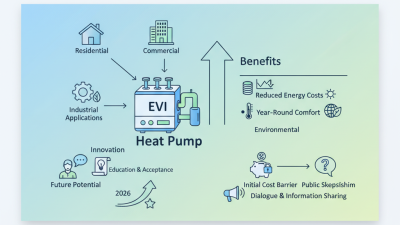
EVI technology enhances vapor injection during compression, helping heat pumps maintain heating capacity and compressor reliability at low outdoor temperatures. The chart shows representative source-temperature operating envelopes commonly used in cold-climate system design; actual performance depends on refrigerant, system configuration, water temperature, controls, and local conditions.

Main EVI Heat Pump Types Available to Global Buyers in 2026

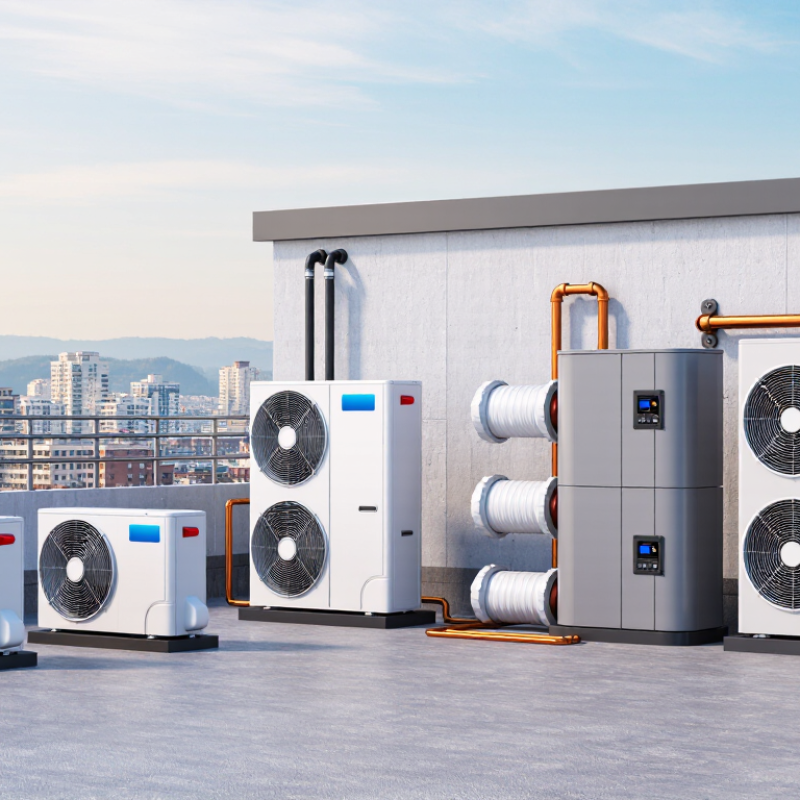
In 2026, global buyers can choose several EVI heat pump types for different climates and buildings. Low-ambient air-to-water EVI units suit cold regions, where enhanced vapor injection supports stable heating below freezing. High-temperature EVI systems serve older buildings with radiators and domestic hot water requirements. Air-to-air EVI units offer faster room heating, but they cannot directly supply hydronic water.

Ground-source EVI systems provide steadier seasonal performance, especially where land and drilling access are available. Commercial buyers often select modular EVI systems with cascade control. One module can operate during mild weather, while additional modules start during peak demand. Monobloc designs simplify indoor installation, whereas split systems may reduce outdoor water-freezing risks. The choice is less simple than many catalogues suggest.

The International Energy Agency reported that global heat pump sales rose by nearly 15% in 2021, showing strong market momentum. Its Future of Heat Pumps report also identifies heat pumps as a major route for reducing heating emissions. The European Heat Pump Association recorded about 2.6 million European sales in 2023. These figures cover heat pumps generally, not EVI models specifically. EVI-specific shipment data remains fragmented.

That gap deserves caution. Buyers should verify tested capacity, refrigerant compliance, noise levels, defrost behavior, and performance at local design temperatures before comparing prices. A unit rated at 7°C may perform very differently at -15°C.

How EVI Heat Pump Systems Operate Across Different Climates

EVI heat pump systems adapt differently across climates because outdoor temperature changes compressor pressure, refrigerant flow, and heating capacity. During cold weather, vapor injection adds intermediate-pressure refrigerant into the compressor. This raises refrigerant mass flow and helps maintain discharge temperature. The result is steadier heating when frost forms on the outdoor coil. The International Energy Agency reports that heat pumps can deliver three to five units of heat for each electricity unit used under suitable conditions.

In northern climates, EVI systems support stronger output at temperatures near -15°C, but defrost cycles still consume energy. The U.S. Department of Energy’s Cold Climate Heat Pump Technology Challenge evaluates performance around 5°F (-15°C), showing why low-temperature testing matters. In humid winter regions, frequent frost can reduce real-world efficiency. Drainage, coil spacing, and defrost controls become practical design details, not minor accessories.

In mild climates, EVI may operate less often because the compressor faces lower pressure differences. Cooling control becomes more important during hot summers. In dry, high-altitude locations, thinner air can reduce outdoor fan performance and heat transfer. Site testing is essential. Reported laboratory ratings can look excellent, yet field results vary with water temperature, installation quality, and user settings. Some assumptions fail. A system sized only for average weather may struggle during a short cold snap. IEA and DOE data support efficiency gains, but local commissioning still decides whether those gains appear in daily operation.

2026 Top EVI Heat Pump Types for Global Buyers - How EVI Heat Pump Systems Operate Across Different Climates

EVI Heat Pump Type Typical Heat Source / Delivery How the EVI System Operates Indicative Heating Conditions* Climate Suitability Key Advantages Main Design Considerations
Air-to-Water EVI Heat Pump Outdoor air to hydronic water; underfloor heating, fan coils, radiators, or domestic hot-water tanks A side port injects intermediate-pressure vapor into the compressor. The vapor increases refrigerant mass flow and reduces discharge-temperature rise during cold-weather operation. Approx. -25°C to 10°C outdoor air; commonly designed for 30°C–55°C leaving water, depending on system and refrigerant Cold and mixed climates; especially suitable where hydronic heating is preferred Good low-ambient heating capacity; can support higher water temperatures than many non-injection systems; suitable for new construction and retrofit projects Capacity and efficiency decrease as outdoor temperature falls; defrost cycles, backup heat, water-flow protection, and low-temperature controls must be correctly sized
Air-to-Air EVI Heat Pump Outdoor air to indoor air through ducted or ductless indoor units Enhanced vapor injection maintains refrigerant circulation and compressor cooling when the outdoor coil is exposed to low temperatures and high compression ratios. Approx. -25°C to 10°C outdoor air; indoor supply-air temperature varies with load, airflow, and indoor-unit design Cold, temperate, and dry continental climates; performance may be affected by frequent frost Fast response, no hydronic distribution losses, and effective space heating where air distribution is acceptable Indoor comfort depends on airflow and humidity control; defrost can temporarily interrupt heating; outdoor-unit placement affects noise and snow exposure
Two-Stage Vapor-Injection EVI System Usually air-to-water or air-to-air; may use two compression stages or a two-stage compression arrangement Compression is divided into stages, while intermediate-pressure vapor is added between stages. This lowers the effective pressure ratio per stage and improves low-temperature operation. Approx. -30°C to 5°C outdoor air in designs intended for severe winter conditions; output temperature depends on application Very cold and subarctic climates, subject to certified operating limits Improved compressor operating envelope, reduced discharge-temperature stress, and stronger heating capacity retention at low ambient temperatures Higher equipment cost and control complexity; oil return, refrigerant distribution, staging logic, and service expertise are important
Flash-Tank EVI Heat Pump Most commonly air-to-water or air-to-air systems using a receiver or flash tank in the refrigerant circuit A portion of liquid refrigerant is expanded in a flash tank. The separated vapor is injected into the compressor, while the remaining liquid is further expanded to the evaporator. Often applied from approximately -25°C to 5°C outdoor air; actual limits depend on compressor, refrigerant, and controls Cold and mixed climates with substantial winter heating demand Provides controlled intermediate-pressure vapor and can improve low-ambient capacity while helping manage compressor discharge temperature Requires accurate flash-tank level control, separator management, and protection against liquid carryover into the compressor
Economizer EVI Heat Pump Air-source or water-source systems using a subcooling heat exchanger and an intermediate expansion path A small refrigerant branch is expanded to an intermediate pressure and evaporated in an economizer heat exchanger. The resulting vapor enters the compressor injection port while the main liquid stream is subcooled. Commonly suitable for approximately -20°C to 10°C outdoor air or low-temperature water-source operation Temperate and cold climates; useful where compact refrigerant circuits are preferred Improved liquid quality at the evaporator, increased refrigerant flow, and better capacity stability at elevated condensing temperatures Heat-exchanger sizing and injection control affect results; efficiency benefits vary with lift, load, and operating temperature
Ground-Source EVI Heat Pump Ground loops or groundwater to hydronic heating and domestic hot water Vapor injection supplements the compressor when a higher water temperature or larger temperature lift is required. The relatively stable ground temperature reduces the extreme lift seen by many air-source systems. Ground-loop entering temperatures commonly remain around 0°C–30°C across the year; leaving-water temperatures are often 30°C–60°C, subject to design Cold, temperate, and hot climates where drilling or ground-loop installation is practical Stable seasonal performance, reduced defrost requirements, and strong suitability for continuous hydronic heating Higher installation cost, site-specific geology, loop balancing, antifreeze concentration, and permitting must be evaluated
High-Temperature EVI Heat Pump Air-source, water-source, or ground-source heat to radiators, process water, or domestic hot water Injection increases compressor mass flow and moderates discharge temperature during high condensing-temperature operation, allowing the system to deliver higher water temperatures within its certified envelope. Typical design targets of 55°C–70°C water; some specialized systems reach higher temperatures under limited conditions Cold and temperate retrofit markets with existing radiator systems or high domestic-hot-water demand Can reduce radiator replacement requirements and support hot-water applications that need more than low-temperature floor heating Higher supply temperatures generally reduce COP; emitter sizing, return-water temperature, anti-scald protection, and periodic high-temperature sanitation cycles require attention

*Data note: Temperature ranges are representative engineering ranges for system comparison, not guaranteed performance ratings. Actual capacity, COP, leaving-water temperature, defrost behavior, and minimum operating temperature depend on refrigerant, compressor design, heat-exchanger sizing, controls, installation conditions, and applicable regional test standards.

Key Performance, Efficiency, and Sizing Factors for Buyers

Enhanced vapor injection (EVI) heat pumps suit buyers facing cold winters and high heating demand. Air-source EVI systems are flexible and easier to install, but outdoor temperature affects their output. Ground-source and water-source types usually deliver steadier performance because their heat sources change less. Check rated capacity, COP, and leaving-water temperature at realistic conditions, not only laboratory ratings.

Sizing requires more than matching the unit to floor area. A heat-loss calculation should consider insulation, window area, air leakage, local design temperature, and domestic hot-water demand. An oversized unit may cycle frequently and waste energy. An undersized unit may rely heavily on electric backup during freezing weather. That balance is often missed.

Tips: Compare capacity at -7°C and colder conditions. Check seasonal efficiency, defrost behavior, sound levels, and minimum operating temperature. Confirm that radiators or underfloor circuits can deliver heat at the planned water temperature. Measure electrical supply and water flow before ordering. Small installation errors matter.

Buyers should also examine maintenance access, filter cleaning, condensate drainage, and frost protection. Independent testing documents are more useful than broad efficiency claims. Real performance can differ because of weather, controls, and building habits. A careful installer should explain these limits clearly. I would leave room for uncertainty, especially when local climate data is limited.

Selecting the Right EVI Heat Pump for Regional Applications

Selecting the Right EVI Heat Pump for Regional Applications

Enhanced vapor injection heat pumps are designed for demanding temperature conditions. Their value becomes clearer in regional applications, not showroom comparisons.

In northern areas, choose an air-source EVI unit tested at low outdoor temperatures. Check heating capacity at -15°C or below, not only the rated output. Reliable defrost control also matters when snow and moisture cover the outdoor coil.

Ground-source EVI systems can suit regions with stable soil temperatures and enough installation space. They usually need careful drilling, water-quality checks, and qualified hydraulic design.

In coastal zones, protective coil coatings and corrosion-resistant fasteners deserve close attention. Hot, humid regions may require strong cooling control, domestic hot-water priority, and effective condensate management. Small details can prevent large service problems.

Electrical conditions vary widely between markets. Confirm voltage, phase, grid stability, refrigerant rules, noise limits, and local safety requirements before ordering.

A unit with excellent laboratory efficiency may perform poorly with undersized pipes or incorrect flow rates. Ask for seasonal performance data and independent test records. Installation experience is not optional here.

A perfect selection rarely exists. Even experienced engineers can overlook maintenance access or winter airflow. Regional feedback should challenge the specification, especially after the first heating season.